Blender / Python / Vectors
spyder
Approved vector contours become editable Blender curves and an inspectable 3D guide.
- Direction
- Krystian Fernando
- Scope
- Blender / Python / Vectors
- Stage
- Private add-on prototype · Version 0.4.0
01 / The story
Look again at the reference.
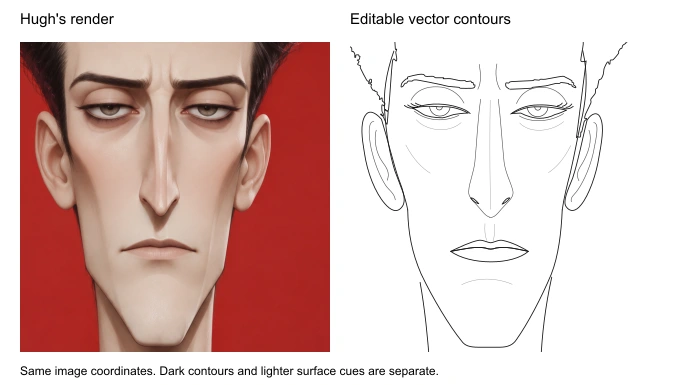
An early scripted sculpt passed numerical checks but changed Hugh’s expression in the wrong way. Returning to the selected render made the next question clear: could the intended contours become an explicit reference?
The face was mapped as named SVG paths. Eye openings, brows, silhouette and softer surface cues could then be inspected against the original image.
02 / The story
Build from the drawing.
The generator reads the approved vectors, maps them into Blender coordinates and uses the existing head to supply depth. The result is a separate guide shell with traceable connections to its source.
The private Blender add-on now previews editable SVG curves and builds or rebuilds the calibrated Hugh guide, with remembered inputs and undo/redo. Its vector core is named vipyr.
03 / The story
A working starting point.
Repeatability and projection checks establish that this specified construction can be regenerated. They do not establish the final likeness or the accuracy of unseen depth.
The guide remains a draft, particularly around the nose and rim. Image-region mapping, multiple-view construction and paired-state animation are research hypotheses for separate studies.
Contribution
Identifying the visual mismatch, proposing the vector/mould approach, directing the reference and reviewing the result. Python and Blender implementation developed with Codex.
Private add-on prototype · Version 0.4.0
Explore the existing research ↗Next project
Sketchiebook
Look at the same detail together.