Questions, methods and evidence
Research
I investigate how people understand, use and shape intelligent systems, then build experiments and visual methods to make their behaviour easier to examine.
01 / Territory
The work begins with what happens between people and intelligent systems.
I’m interested in the moment a system’s output becomes meaningful to someone: when it feels coherent, confusing, playful, useful or unexpectedly social.
That makes the research larger than model performance alone. It includes the instructions a system receives, the form of the interaction, the judgment used to interpret a response and the visual tools that make the relationship inspectable.
01 / Diagram
A connected research territory
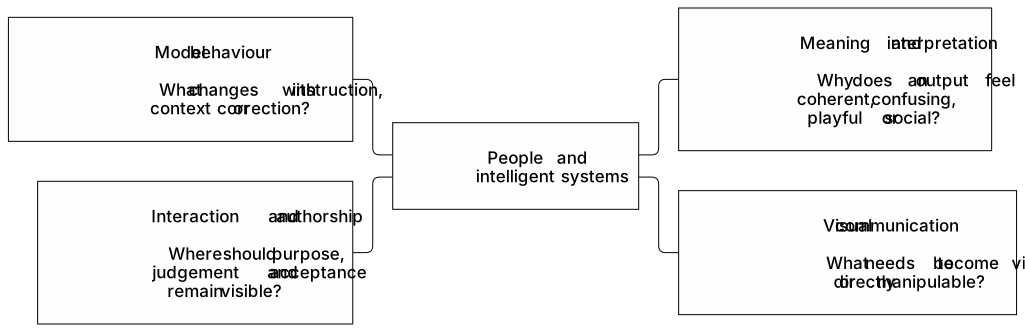
Four recurring areas, connected by the same concern: how a person encounters, interprets and directs an intelligent system.
Editable draw.io source02 / Method
Keep the question, the evidence and the human decision attached.
My work usually starts with an observation that does not yet have a formal name. I find the question inside it, build the smallest useful experiment and preserve what happened closely enough to inspect it again.
Polinko is the research model I developed for this work with language models. It keeps source material distinct from interpretation, gives evaluation a defined question and leaves acceptance with human judgment.
Polinko is one implementation of the method, not the boundary of the practice. The same movement appears in visual collaboration, interface review, media production and the tools that emerge from them.
02 / Diagram
A recurring movement through the work
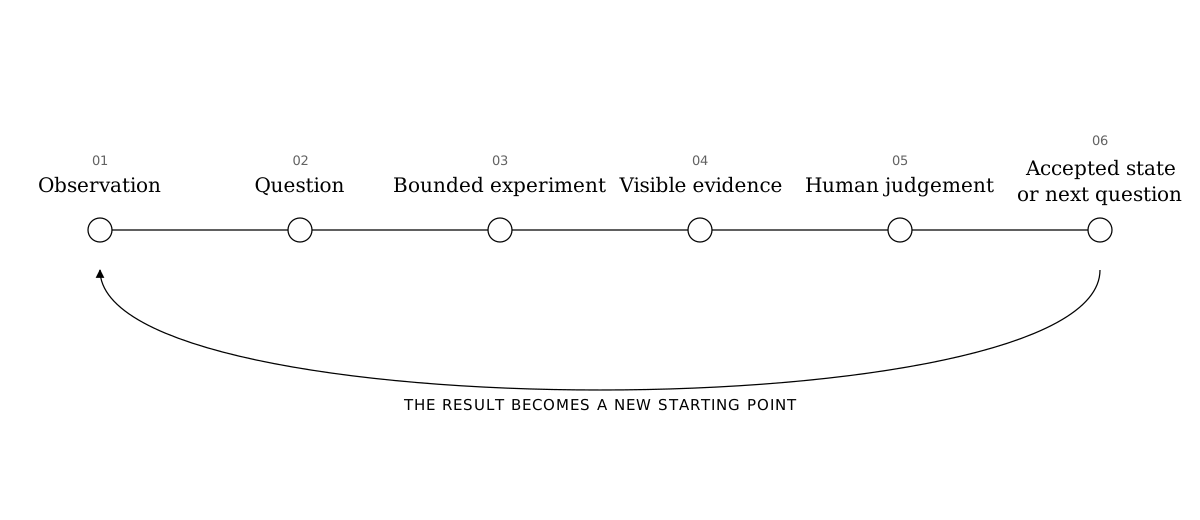
The movement can repeat without erasing its earlier state. A result may become accepted evidence or reveal the next question.
Editable draw.io source03 / Current threads
Different objects, connected questions.
Model behaviour and meaning
What makes a response feel connected to its source?
I study how instruction, context and correction affect coherence, relevance, character and the meanings people find in generated responses.
Interaction and authorship
Where should human judgment remain visible?
I design working relationships in which automation carries out precise operations while purpose, interpretation and acceptance stay human-owned.
Visual tools for thinking
What should become directly manipulable?
I build instruments when an existing interface cannot preserve the way a question, image, layout or decision needs to be examined.